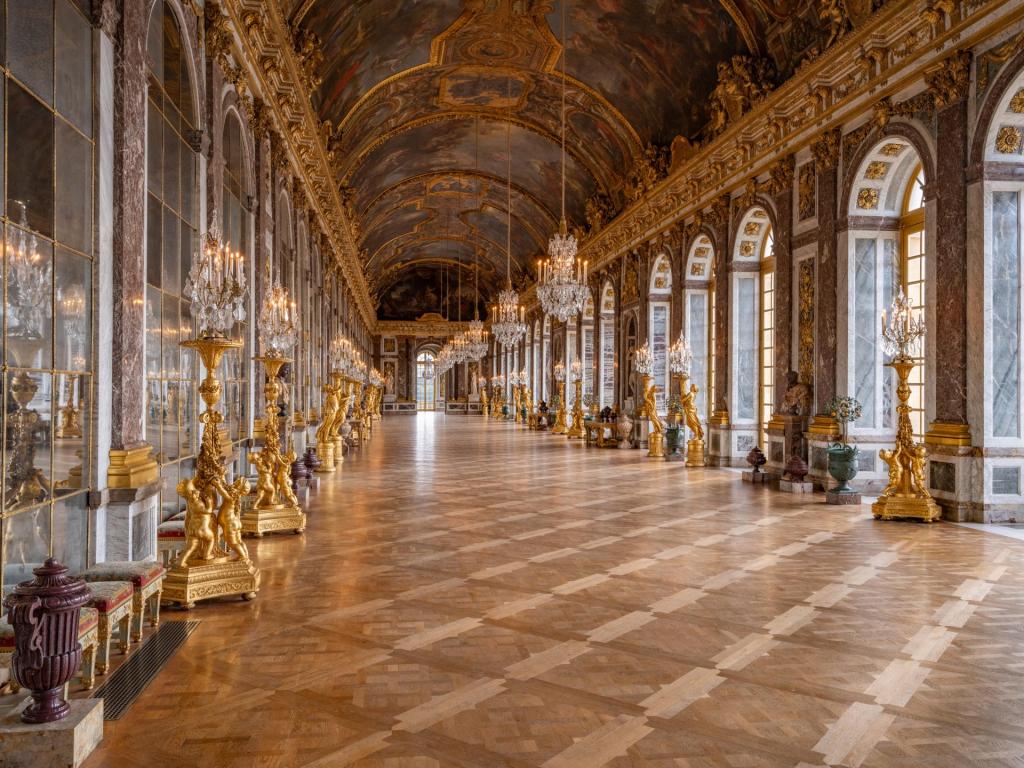
The Hall of Mirrors, again
In my last post, I wrote that Versailles’s Hall of Mirrors was built between 1678 and 1684. We are seventeen years away from Nicolas Fouquet‘s magnificent feast, held at Vaux-le-Vicomte, on 17 August 1661, in honour of Louis XIV.
As France’s Superintendent of Finances, Fouquet expected and was expected to replace Jules Cardinal Mazarin as First Minister of France. As for Louis XIV, king of France, he was a twenty-two year old king in 1661. He was jealous and believed what Jean-Baptiste Colbert told him about Fouquet, his, Colbert’s, rival. Colbert wanted to replace Mazarin. Louis could see that Fouquet was too rich and Vaux-le-Vicomte, his château, so beautiful that it seemed made for a king. On 5 September 1661, musketeer d’Artagnan arrested an unsuspectful Fouquet in Nantes.
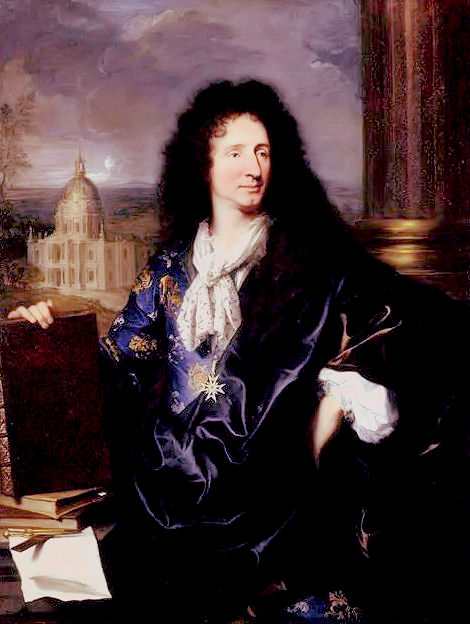
With Fouquet in custody, the young King promptly hired the team who had built Vaux-le-Vicomte: architect Louis Le Vau, artist Charles Le Brun, and landscape designer and gardener André Le Nôtre. They built Versailles, except its jewel: the Hall of Mirrors.
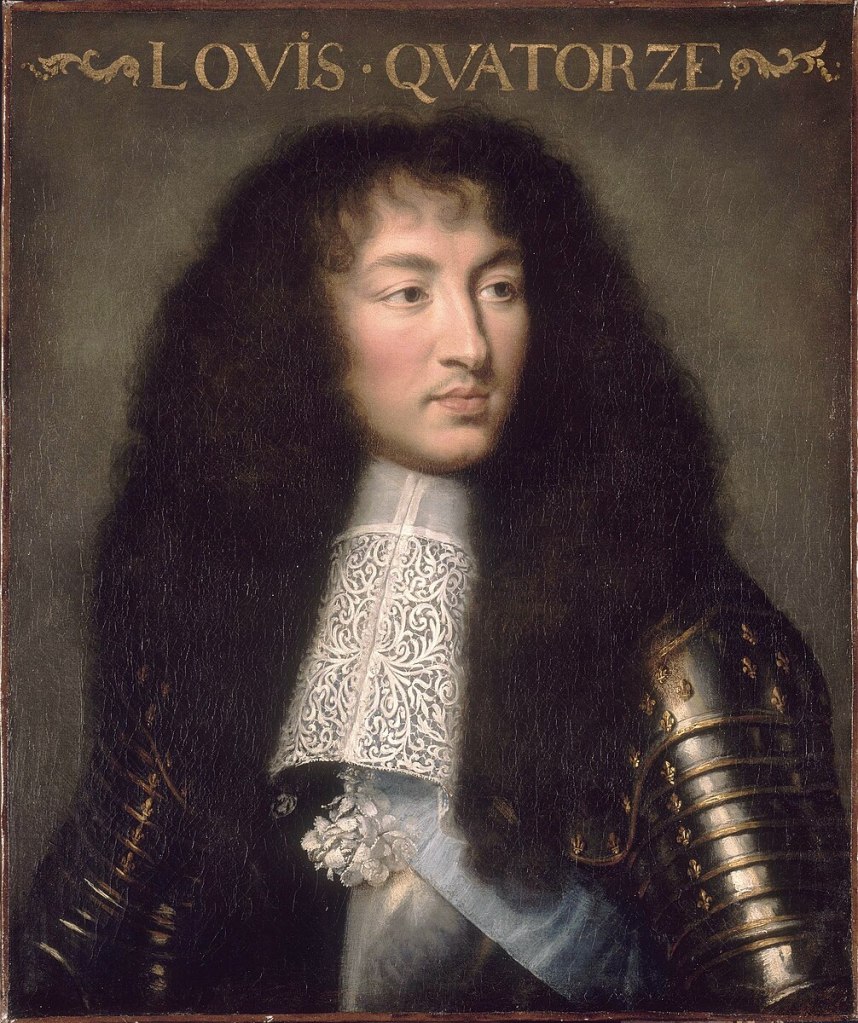
In my heart I prefer fame above all else, even life itself.…Love of glory has the same subtleties as the most tender passions.…In exercising a totally divine function here on earth, we must appear incapable of turmoils which could debase it. Louis XIV quoted in Louis XIV, Britannica.
In 1661, when he visited Vaux-le-Vicomte, Louis had yet to prove that he was an absolute monarch, and quite literally, God on earth. But he would cultivate this concept. He had a public lever and coucher ceremonial when he rose and went to bed.
The Hall of Mirrors was a useful addition to Versailles. Before it was built, the king and courtiers had to walk outside to go from the King’s bedchamber, to the North, and the Queen’s bedchamber, to the South. The Hall of Mirrors would face West.
The Treaties of Nijmegen
More importantly, between August 1678 and October 1679, the Treaties of Nijmegen were signed.
The Treaties of Nijmegen ended various interconnected wars among France, the Dutch Republic, Spain, Brandenburg, Sweden, Denmark-Norway, the Prince-Bishopric of Münster, and the Holy Roman Empire. (Treaties of Nijmegen, Wikipedia). And, they also ended the Franco-Dutch War that had begun in 1672.
In short, by 1678, Louis XIV had become a military hero. So, I would presume that this victorious and more mature and victorious Louis would not have inflicted so heavy and unwarranted a fate to Nicolas Fouquet, France’s superintendent of Finance. In fact, Fouquet, who was at Pignerol, now Pinerolo in northwest Italy, was allowed to see members of his family in the 1670s. He died in 1680 when his son was visiting.
Louis Le Vau, Versailles’s first architect, had died in 1670.
.

 Micheline's Blog
